


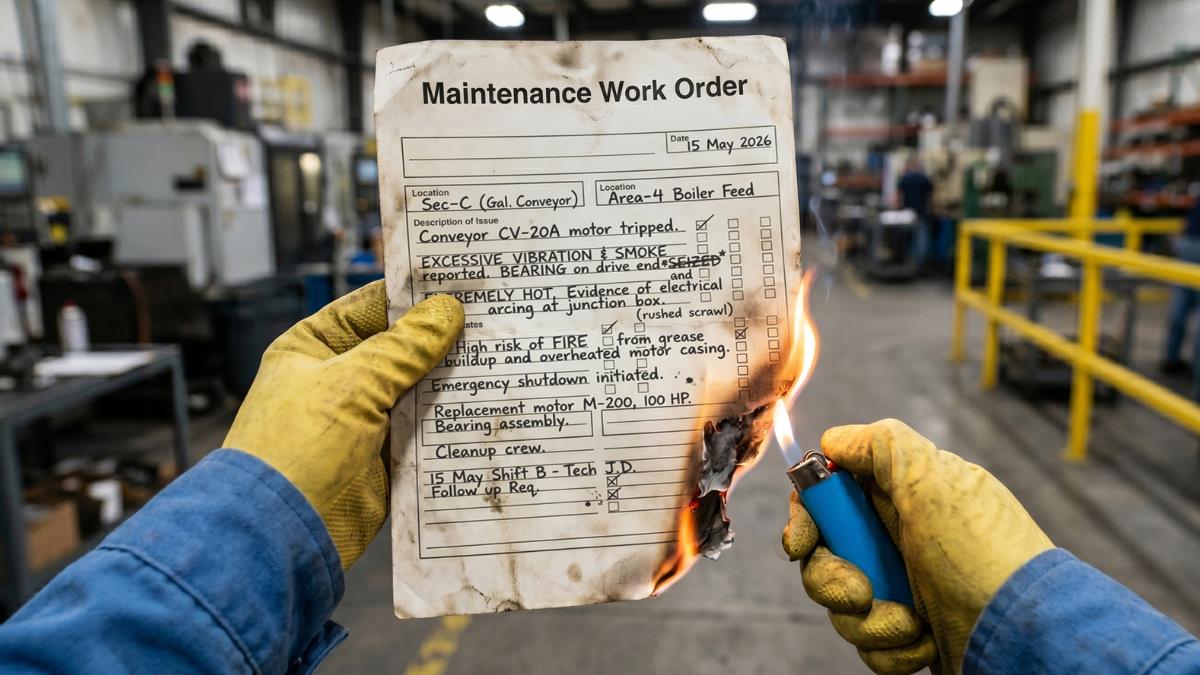
Many maintenance teams are working to improve reliability while still managing critical preventive maintenance tasks with paper routes, handwritten notes and manual data entry. The process is often familiar, but familiarity should not be confused with efficiency.
A typical paper-based workflow creates friction at nearly every step. Planners print and distribute PMs. Technicians complete inspections in the field and record findings by hand. Photos may be taken on a phone but sent separately by text or email. Completed forms eventually return to a planner or scheduler, who must interpret the notes and enter the information into another system.
That workflow may technically “work,” but it often works by consuming time, separating useful information and making reliability data harder to see and difficult to use. For lubrication tasks in particular, the limitations are clear. Lubrication is repetitive, route-based and detail-heavy. If the work is not clearly defined, documented and reviewed, small errors can accumulate into expensive failures.
A Lubrication Management System, or LMS, is one way maintenance teams can modernize this part of the PM process. Noria’s LubePM is an example of this type of system, but the broader issue is not about any specific platform. The larger question is whether the tools used to manage lubrication work are appropriate for the importance of the assets being maintained.
The Hidden Cost of Paper-Based PMs
In many plants, the traditional lubrication PM process begins with printed routes. Someone generates the work, prints the documents and hands them to the lubrication technician or maintenance technician. The technician performs the route, writes down observations and returns the paperwork. From there, someone else reviews the notes and often re-enters the information into a CMMS or another tracking system.
That is not a streamlined process. It is a chain of administrative handling around the actual maintenance work.
The inefficiency becomes more obvious when abnormal conditions are found. Suppose a technician identifies a leaking lubrication supply line on a gearbox. On paper, the inspection note may say “leak observed,” but the supporting photo may exist somewhere else entirely: on the technician’s phone, in a text message, in an email thread or in a shared folder. Unless someone manually connects the image to the inspection record, key context is lost.
That separation matters. A written note can describe a problem, but a photo can show severity, location, accessibility, contamination risk and whether the condition is getting worse. When photos, notes and task records are disconnected, planners and reliability leaders are left with fragments instead of a complete maintenance record.
A digital lubrication workflow helps keep those details together. The inspection result, photo, annotation, asset record, task history and follow-up action can all remain connected. That doesn’t just make documentation cleaner. It makes the information more useful.
Why the CMMS Is Not Always Enough
Most plants already have a CMMS, so it is reasonable to ask why another system would be needed. The answer is that a Lubrication Management System is not intended to replace the CMMS. It is intended to support it by managing a level of lubrication detail that many broad maintenance systems do not handle effectively.
A CMMS is typically the system of record for maintenance activity. It may track assets, work orders, labor, parts, costs, compliance and maintenance history. In many facilities, it contains a broad asset hierarchy that includes everything from production equipment to facility infrastructure. That breadth is useful, but it can create noise when the goal is to manage lubrication work with precision.
Lubrication requires more granular task control than many generic PMs provide. A work order that says “grease bearings” may not be enough. The technician needs to know which bearings, which lubricant, how much to apply, what method to use, what condition checks to perform and what abnormal findings should be documented.
That kind of detail is where a dedicated LMS can add value. It can manage the route, procedure, lubricant, quantity, task frequency, inspection criteria and supporting documentation in a structure designed specifically for lubrication work.
A LMS does not replace a CMMS, it augments it. The CMMS still matters and remains as a key component in the larger maintenance system. But an LMS can serve as the execution layer for lubrication tasks, providing cleaner information back to maintenance and reliability teams.
Better Planning and Scheduling
A major benefit of digital lubrication management is improved planning and scheduling. Lubrication work is often recurring, route-based and affected by equipment availability. Production schedules change. Shutdown windows move. Staffing levels vary. Certain tasks may need to be shifted, grouped or prioritized based on operating conditions.
When this work is managed on paper, schedule changes often require reprinting routes, redistributing paperwork and manually reconciling completed tasks. That adds unnecessary effort and increases the chance that something will be missed or even misreported.
A digital system can allow planners to view upcoming lubrication tasks, move dates, adjust routes and coordinate work more easily. That flexibility is important because preventive maintenance is not just about generating tasks. It is about making sure the right work is done at the right time, with the right information available to the person doing it.
For maintenance leaders, this creates better visibility into work execution. They can see what was completed, what was missed, what abnormal conditions were found and where follow-up may be needed.
Turning Field Observations Into Reliability Data
The strongest argument for digital lubrication management is not convenience. It’s data quality.
Paper PMs are poor at turning field observations into usable reliability data. Even when technicians complete forms accurately, the information often has to be interpreted and manually entered before anyone can analyze it. That creates delays, transcription errors and inconsistent terminology. It also increases the chance that important observations may simply be “pencil-whipped” and will never be reviewed beyond the immediate completion of the route.
A digital workflow makes it easier to capture and trend lubrication-related information over time. This may include missed tasks, recurring leaks, lubricant consumption, abnormal inspection findings, contamination observations, repeat failure locations, route completion rates and corrective actions generated from PM findings.
That data allows maintenance teams to ask better questions:
- Are certain assets repeatedly showing lubrication-related problems?
- Are the same routes frequently incomplete?
- Are technicians finding issues that are not turning into corrective work?
- Are lubrication tasks being performed consistently across shifts or sites?
- Are recurring leaks, contamination points or access issues being addressed?
These questions move the program beyond simple checkbox compliance. A completed PM is useful only if the work was done correctly and the information gathered from the task leads to better maintenance decisions.
Supporting Workforce Transition
Many plants are also dealing with a changing workforce. Experienced technicians are retiring, and newer employees are entering the field with different backgrounds and skill sets. In the past, lubrication knowledge often lived informally with long-tenured employees – “tribal” knowledge. They knew which fittings were hard to reach, which gearboxes tended to leak, which bearings were sensitive to overgreasing and which machines required special care.
The problem is that such tribal knowledge is fragile. When experienced people leave, much of that knowledge walks out the door with them.
A LMS can help convert field knowledge into structured procedures. Each task can include the correct lubricant, application quantity, method, route location, inspection criteria, photos, notes and safety considerations. This gives newer technicians clearer instructions and helps reduce dependence on memory or informal coaching.
This does not eliminate the need for hands-on training. Lubrication is still a skilled maintenance activity, but better procedures make training easier to reinforce and execution easier to standardize.
Reducing Rework and Administrative Drag
Paper workflows often require the same information to be handled multiple times. A planner creates or prints the PM. A technician completes it by hand. A planner reviews it. Someone enters the results into another system. Someone else may later search for supporting photos, scan the paperwork or reconcile the task history.
That is unnecessary rework, and it adds up.
A digital lubrication workflow allows the technician’s field entry to become the record. Inspection notes, completion status, photos and comments are captured once and remain tied to the task and asset. This reduces administrative handling and limits the chance that information will be lost between the field and the planning office.
For technicians, this can provide clearer task instructions. For planners, it can reduce time spent decoding handwritten notes or chasing missing information. For reliability leaders, it can improve visibility into whether PM work is being completed properly and whether findings are being acted on.
Managing Resistance to Change
Resistance to new systems is common, and it should not be brushed aside. Some technicians do not want to carry a phone or tablet along with their normal tools. Some plants are concerned about adding another system when they already have a CMMS. Others are simply used to paper routes and do not see an immediate need to change.
Those concerns are valid, especially if the new system is poorly implemented. A digital tool that adds complexity without improving execution will not help the maintenance team. It will become another administrative burden.
The goal should not be to add software for its own sake. The goal should be to make the work clearer, more consistent and easier to manage. A LMS should reduce duplicated effort, improve task quality and provide better information to planners, supervisors and reliability teams.
Implementation also matters. Routes need to reflect real field conditions. Asset data must be accurate. Lubricants, quantities and procedures must be reviewed. Technicians need training. Supervisors need to use the information coming back from the field. Without those fundamentals, the system will not solve the underlying problem.
Technology can support a better process, but it cannot be a substitute for one.
Modern Maintenance Requires Better Execution Tools
Many plants invest heavily in advanced production equipment while continuing to manage essential maintenance tasks with paper forms and handwritten notes. That mismatch deserves scrutiny. Even the most advanced equipment still depends on disciplined maintenance execution, and lubrication remains one of the most fundamental reliability practices.
Paper PMs may be familiar, but they often limit visibility, weaken data quality and make it harder to standardize work. For lubrication tasks, where details such as lubricant type, quantity, frequency, inspection criteria and task history matter, those limitations can directly affect asset reliability.
A Lubrication Management System is not a replacement for a CMMS, and it is not a shortcut around good maintenance practices. It is a specialized tool for managing a specialized part of the maintenance process. Used correctly, it can help maintenance teams improve planning, standardize task execution, preserve field knowledge and context, reduce administrative rework and turn routine PMs into useful reliability data.
For plants still relying on paper lubrication routes, the question is not whether the old process can continue. It probably can. The better question is whether it should continue, when considering the compromises that would be required.